You’ve probably touched a “leather” jacket that turned out to be plastic within six months. Or bought a wallet that looked great in the store and started peeling at the corners before winter ended. Everyone has experienced it once; you burn your hand, and then you’re mindful of it!
The great news is that you don’t have to be an expert at tanneries to distinguish between good and bad leather. You only have to understand what you’re really looking for before giving your hard-earned cash. Here’s how.
Smell It First
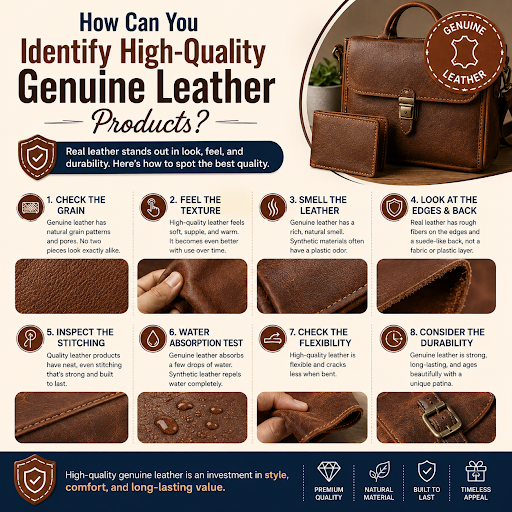
This may seem unusual, but it does work. Real leather is unmistakably natural with a strong earthy aroma that has a hint of sweetness. Fake leather typically has a plastic or chemical aroma or, sometimes, a faux leather fragrance sprayed on it that works for those who haven’t been exposed to the real leather long enough to pick out the distinction.
If you walk up to a bag and it smells like a new shower curtain, that’s your answer.
Check the Grain — And Look for Imperfections
Real leather isn’t perfectly uniform. It is of animal origin, so there are natural variations: very fine-grained, very fine marks, slight color changes from one part of the piece to the next. If the print seems perfect and repeats in a pattern, it’s probably a synthetic print or an inferior leather delicately coated.
Try to rub or run your finger over the surface. Genuine, high-quality leather has texture you can actually feel, small ridges, slight irregularities. Faux leather tends to feel flat and almost too smooth, like it was stamped from a mold.
Press It and Watch What Happens
Here’s a trick a lot of people don’t know: press your finger into the leather and watch how it reacts. Real leather is slightly stretchy and has a slight wrinkle or impression where it was pressed, and gradually recovers. Faux leather typically comes back in an instant, or it may not move at all if there’s a stiff underlayment.
It is one of the most obvious indications that you’re not dealing with fake hide: a give that small delay.
Look at the Edges
This one’s easy to miss but tells you a lot. The edges of the real leather are cut, similar to the edge of a stack of paper when observed closely. These edges are often burnished or waxed to seal them in a clean fashion by manufacturers. Faux leather edges tend to be more plastic-like and lack varying textures and colors, and sometimes it’s possible to see the backing fabric of the faux leather if you look closely enough.
Turn over and inspect the reverse side of a flap or inside of a strap. This is where you’re most likely to see the low-quality materials show their shortcomings the quickest.
Pay Attention to the Weight
Genuine leather has heft. It’s not always heavy, but it is dense, being made of an actual animal hide, not coated fabric. Take any two bags, a real and a synthetic, and you will typically be able to tell the difference at a glance. The true one is substantial and can’t be faked.
Ask About the Tanning Process
Anyone selling premium leather should be able to tell you how it was tanned. Vegetable-tanned leather gets richer and deeper in color over the years with use. Chrome-tanned leather is more prevalent, more pliable, and maintains color better, but does not get that natural patina.
When a seller doesn’t have an answer to a simple question like this, it is worth noting. If someone truly has a passion for what they do, they will talk about it, look out for those who get vague or who do not answer the question you are asking.
Watch How It Wears In, Not Just Wears Out
One of the biggest tells of real leather is how it changes with use. Top-quality leather doesn’t wear out; it gets interesting. Softens creases, darkens slightly in color, a natural sheen to the surface from handling. This is called patina and is the best part of real leather!
Faux leather doesn’t do this. It just wears out. No patina, no character, only gradual deterioration, until it begins to crack and peel.
Where You Buy It Matters as Much as What You Buy
Even genuine leather can vary wildly depending on who’s making it and how much care goes into production. A small maker focused on quality control will usually catch flaws that a mass-production line would let slide. Brands producing Alaskan leather bags USA style goods, for instance, tend to lean on tougher, thicker hides built for actual wear and tear, not just how something photographs for an online listing.
The same goes for smaller operations building things like custom briefcases USA. When a maker is working in smaller batches, there’s simply more attention on each individual piece, from stitching quality to how the edges are finished.
Trust Your Gut, Not Just the Price Tag
Here’s the thing a lot of people get wrong: price alone doesn’t guarantee quality. Plenty of overpriced items use mediocre leather dressed up with a big brand name, while smaller, lesser-known makers sometimes produce genuinely better material for less. Use everything above: the smell, the texture, the weight, the edges, rather than assuming a higher number on the tag automatically means better leather.
Final Thoughts
Identifying good leather isn’t complicated once you know what to look for. Smell it, feel it, press it, turn it over and examine the edges. Ask questions the seller should have no hesitation in answering. You will no longer be taken in by leather that seems good at first, but flakes off after less than a year, and you will begin to purchase leather that is worthy of the tag.
