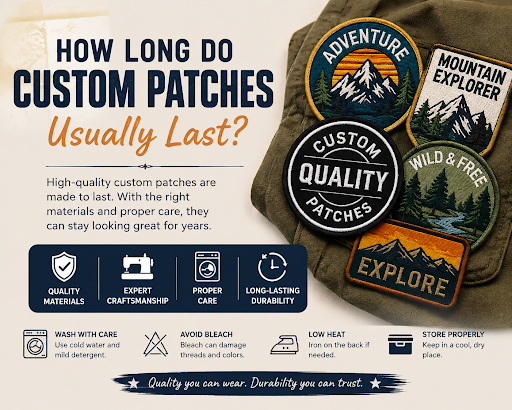
Patch customization involves more than just adding an attractive design. They are created to represent a particular team, firm, group, organization, institution or personal accomplishment; therefore, people expect such items to last for many years. Regardless of whether they are applied to uniforms, jackets, backpacks, caps or work apparel, the ability to withstand time is among the key considerations made before ordering customized patches.
The lifespan of a patch is determined by more aspects than its visual appeal. The nature of material, manufacturing process, attachment technique and exposure to cleaning, sunlight and mechanical wear and tear are among the aspects influencing the longevity of patches. While certain patches retain their good condition for many years, other patches tend to wear out quickly as a result of the environment and poor maintenance.
Knowing what factors influence the life span of patches is useful for making informed choices when buying them. Rather than just considering the style and cost of the patch, it is better to know how various kinds of patches behave in order to pick the one that will best suit the buyer’s needs.
The following article gives insight into what affects the life expectancy of customized patches and how they can be made to last longer.
Why Do Some Custom Patches Last Longer Than Others?
Perhaps the most significant difference between long-lasting and non-lasting patches is the way they were made. Patches made of durable fabrics with strong threads and dense stitching and proper backing tend to be more resistant to wear and tear.
The other significant factor that impacts the lifetime of patches is their use. Patches that are used as decorative elements of garments worn occasionally suffer less damage compared to patches that are used in uniforms being washed once a week. Moisture, dust, friction, chemicals, and even sunlight affect all textile products, including patches.
Patches should also meet the standards set by their producers. The good quality professional production process always includes testing of the products to make sure that the stitching will not come off and the edges will stay neat.
What Is the Average Lifespan of a Custom Patch?
Most of the commercially produced patches can easily withstand up to five or ten years, and sometimes even longer depending on the care.
Factors that determine how long the patch can survive are:
- Usage rate
- Washing routines
- Methods of attachment
- Exposure to the environment
- Quality of the fabric
- Quality of the thread
- Stitch count
- Storage methods
Patch used daily on working clothes naturally faces much more wear and tear than the one mounted on the collectible clothes.
In many companies, patches usually stay intact for the whole lifespan of the uniform.
How Does the Patch Material Affect Durability?
Various base materials behave differently during normal use.
Twill Fabric
Twill fabric is considered to be one of the most common fabrics since it has a tough surface which helps prevent stretching or shrinking.
Its advantages are:
- Great strength
- Good color retention
- Smooth embroidered surface
- Usable on a daily basis
Felt
Felt gives an elegant look which is traditionally found on varsity jackets and patches.
While elegant, felt absorbs more moisture compared to twill and tends to wear out easily with prolonged use.
PVC
PVC patches consist of rubber rather than cloth material. PVC patches are highly resistant to water, mud, chemicals, and sunlight.
Leather
Leather patches add value with age but need regular conditioning to avoid cracking.
Which Type of Stitching Offers the Longest Life?
The embroidery itself has great significance when it comes to durability.
More stitches lead to:
- Greater resistance against wear
- Better shape retention
- Increased thread coverage
- Protection of the basic fabric
But too many stitches may cause some fabrics to become rigid, hence manufacturers need to balance between both durability and flexibility.
Polyester thread used in modern embroidery is highly favored due to its resistance to:
- Sunlight
- Water
- Mold
- Friction
- Washing
How Does the Attachment Method Influence Longevity?
How the patch is attached will largely determine its longevity.
Sewed On Patches
Sewing is the most durable way to attach a patch.
Its advantages include:
- Very strong
- Washing resistant
- Repairable if stitch work wears out
- Best for uniforms and heavy duty clothing
Most military, police, and work uniforms use sewed on patches due to their durability.
Iron-On Backing
The iron-on adhesive offers convenience and a neat look without any stitches visible.
Nevertheless, frequent washing at high temperatures may damage the adhesive over time, especially if the patch is not sewn as well.
Hook-and-Loop Backing
The hook-and-loop backing system will prove helpful in those cases when frequent removal/replacement of the patches is necessary.
While the patch can remain functional for years, the fastener is likely to become ineffective due to wear and tear.
Adhesive Backing
Peel-and-stick patches are mostly meant to be worn temporarily, not permanently.
What Environmental Conditions Reduce Patch Lifespan?
There are a number of environmental factors which impact textiles slowly over time.
Some of the main ones include:
- Repeated washing in a machine
- High heat when using a dryer
- Consistent UV light exposure
- Friction
- Industrial chemicals
- Salt water
- Mud
- Oil
- Perspiration
Uniforms for outdoors certainly receive more wear and tear compared to indoor uniforms.
The good news is that most of these issues can be controlled by proper care.
How Can Proper Care Extend Patch Life?
Proper care makes a big difference.
Some basic maintenance includes:
- Washing clothes in reverse
- Washing clothes in cold or lukewarm water
- Selecting a gentle washing cycle
- Not using strong bleach
- Air drying where possible
- Keeping clothes in dry places
- Keeping clothes away from direct sun exposure while stored
This helps avoid unnecessary stress to the patch and its surroundings.
Which Patch Style Is Best for Different Uses?
The optimal type of patch is determined by its intended use.
| Purpose | Optimal Type of Patch | Reason for Optimal Performance |
| School uniforms | Embroidered | Professional and durable |
| Corporate branding | Woven | High quality and neat finish |
| Outdoor clothes | PVC | Water and dirt proof |
| Motorcycle clubs | Embroidered | Strong and classic |
| Sport teams | Embroidered | Washable |
| Tactical clothing | PVC | Water and dirt proof |
| Fashion clothes | Chenille or Embroidered | Aesthetically appealing |
When Should a Patch Be Replaced?
All patches are not necessarily needed to be replaced just because they look old.
It will be worth while to replace when:
- The stitching starts to fray.
- The backing comes off completely.
- The colors fade.
- The patch loses its shape.
- The edges fray.
- The logos are not clearly visible anymore.
It is important for organizations to keep a good appearance.
Can High-Quality Patches Handle Everyday Wear?
Yes. Professionally made patches are intended for use through many industries.
Depending on whether you attach them to uniforms, jackets, backpacks or promotional clothes, high-quality materials used together with skillful crafting will make patches endure for years of normal usage.
Having chosen the proper materials and the method of attaching, many people prefer custom patches for cloth as they provide a practical means of personalizing clothes along with their durability.
It all comes down to how well the patches are made and maintained.
Inspection is also a good way of checking for loosened threads that may eventually ruin your patch.
When uniforms are ordered in bulk by any organization, the manufacturing consistency of these patches ensures that all the patches have similar performance throughout their lifecycle.
Professional suppliers also suggest choosing the right back material according to the use of the garment and not just depending on convenience.
The custom embroidered patches in UK are chosen by businesses, schools, clubs, and sports teams due to their professional look and durability.
Why Is Choosing the Right Manufacturer Important?
The life span of a patch starts even before attaching the patch to any clothes.
Skilled producers always take care of:
- Material choice
- Thread selection
- Stitch density
- Edge finish
- Backings
- Color uniformity
- Accuracy of production
- Quality control
Quality production usually results in low maintenance cost since the patch stays beautiful for a very long time compared to cheaper products.
Frequently Asked Questions
How long do embroidered patches usually last?
Professionally made embroidered patches commonly last between five and ten years, and often longer when properly cared for.
Do iron-on patches eventually fall off?
Iron-on patches can remain secure for years, but heavy washing and frequent heat exposure may weaken the adhesive. Sewing them provides additional security.
Can patches survive regular machine washing?
Yes. Quality patches are designed to handle regular washing, especially when garments are washed on gentle cycles using cold or lukewarm water.
Does sunlight damage embroidered patches?
Extended UV exposure can gradually fade thread colours over time, although modern polyester embroidery thread offers excellent resistance.
Which attachment method lasts the longest?
Sew-on patches generally provide the greatest long-term durability because stitching remains secure through repeated washing and daily wear.
Ready to Invest in Durable Custom Patches?
The use of premium materials, quality embroidery, and suitable attachment processes is what can greatly enhance the life span of a patch. When it comes to needing patches for your uniforms, club, business, school, or any other individual needs, the assistance of experienced individuals is very helpful.
Explore more about professionally made patches at www.uk.custompatched.com.
Conclusion
Custom-made patches are designed to be durable, but there are various interconnected elements affecting their lifespan, which include the quality of the materials, stitching, backing, environmental conditions, and maintenance. If the patches are well made, they may look good for a long time, particularly when combined with the appropriate attachment techniques and proper care.
Knowing what affects the longevity of the patches enables people and businesses to select patches depending on the intended application, thus avoiding frequent replacement.
